• edited by
5,028 views

1 Answer

1 1 vote


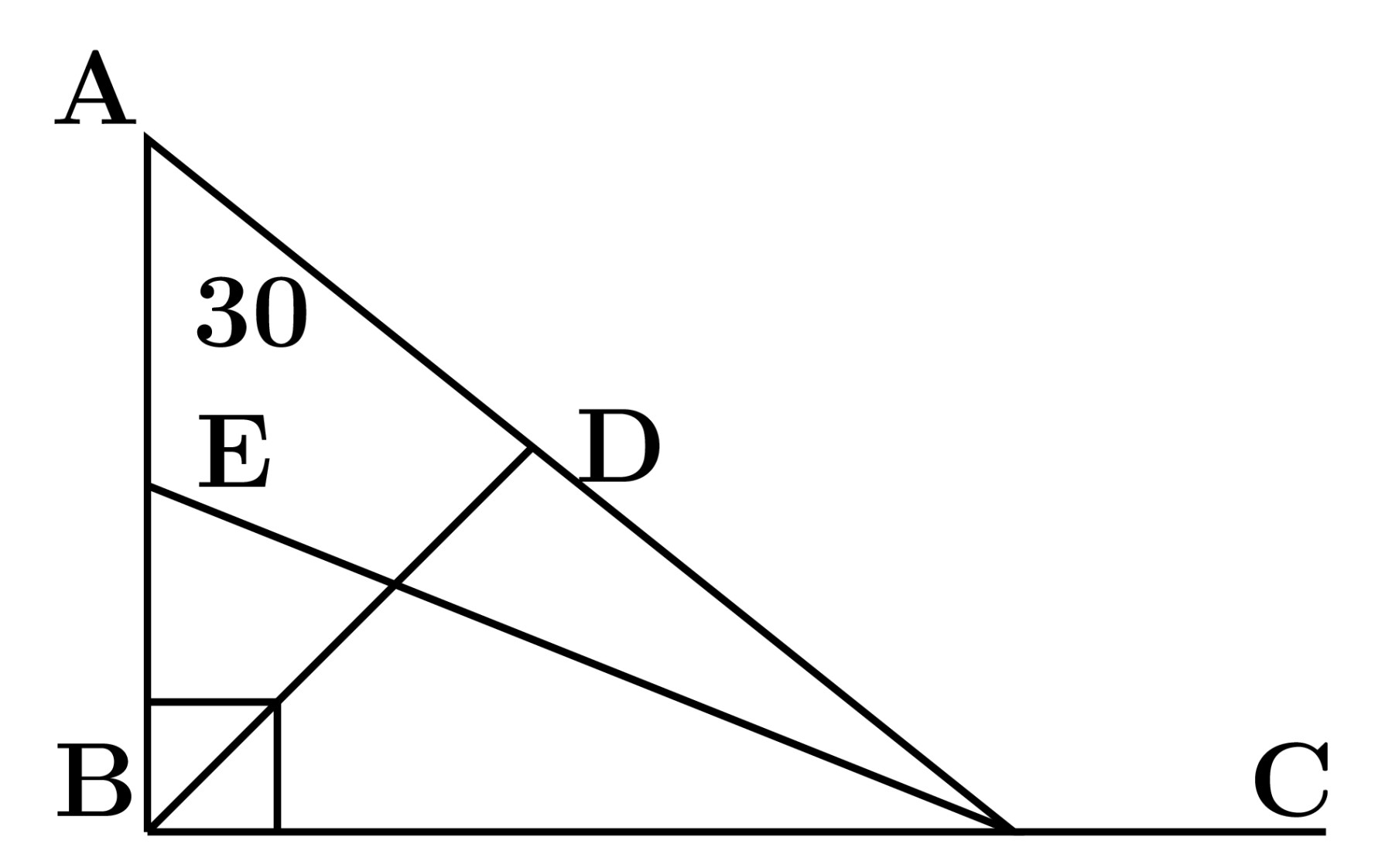
$AB\perp BC$ & $BD \perp AC$

∴$\measuredangle ABC = 90^{\circ}  $ & $\measuredangle BDA = \measuredangle BDC = 90^{\circ}$

Now, $\angle BAC = 30^{\circ}$

∴$\measuredangle ACB = 180^{\circ} - (90^{\circ}+30^{\circ})$

$\measuredangle ACB = 180^{\circ} - 120^{\circ}$

$\measuredangle ACB = 60^{\circ} $

Given that $CE$ bisects $\angle C$ 

$∴ \measuredangle ECD =  \dfrac{60^{\circ}}{2}= 30^{\circ}  $

Then, $\measuredangle CED = 180^{\circ} - (90^{\circ}+30^{\circ}) = 60^{\circ}$

• edited by
Position:
Show:
Answer:

Related questions

1 1 vote
1 1 answer
1.9k
1.9k views
Misbah Ghaya asked Aug 31, 2017
1,914 views
What is the area of the triangle?I. Two sides are 41 cm eachII. The altitude to the third side is 9 cm long.if the questions can be answered with the help of both the sta...
2 2 votes
1 1 answer
3.4k
3.4k views
Misbah Ghaya asked Aug 31, 2017
3,396 views
What is the length of the rectangle ABCD?I. Area of the rectangle is 48 square unitsII. Length of the diagonal is 10 unitsIf the questions can be answered with the help o...
1 1 vote
1 1 answer
3.5k
3.5k views
Misbah Ghaya asked Aug 28, 2017
3,466 views
ABCD is a square of area 4, which is divided into four non-overlapping triangles as shown in the figure. The sum of the perimeters of the triangles is:$8(1+\sqrt{2})$$8(2...
0 0 votes
0 0 answers
284
284 views
Shubham Sharma 2 asked Jul 28
284 views
A triangle $\text{ABC}$ is formed with $\text{AB}=\text{AC}=50 \mathrm{~cm}$ and $\text{BC}=80 \mathrm{~cm}$. Then, the sum of the lengths, in $\mathrm{cm}$ , of all thre...
0 0 votes
0 0 answers
630
630 views
Shubham Sharma 2 asked Jun 26, 2025
630 views
The coordinates of the three vertices of a triangle are: $(1,2),(7,2)$, and $(1,10)$. Then the radius of the incircle of the triangle is